“She loved her British family”
In a world where AI is used for almost everything, even creative writing, we chose to begin somewhere deliberately human: with human emotions. It was a deliberate choice. We sat in a meeting room in Phoenix Court, Kings Cross, London, home of SOFIAA Health, and began talking.
About Uncertainty. Anxiety. Fear. Warmth. Love. The instinct to protect those we care about. From these emotions, story began to take shape. Using the OSPA framework, we turned those human experiences into disciplined storytelling, exploring the factors driving long-term structural change, the vulnerabilities within systems, and the consequences that emerge when different forces collide. The framework gave our imagination structure, but the story itself remained profoundly human.
When the scenario was finished, we struggled to name it. Nothing seemed capable of catching its richness. Only then did we first turn to AI. It offered titles such as Reversal of World Order, but they felt too grand, too abstract, too removed from the two lives at the heart of the story.
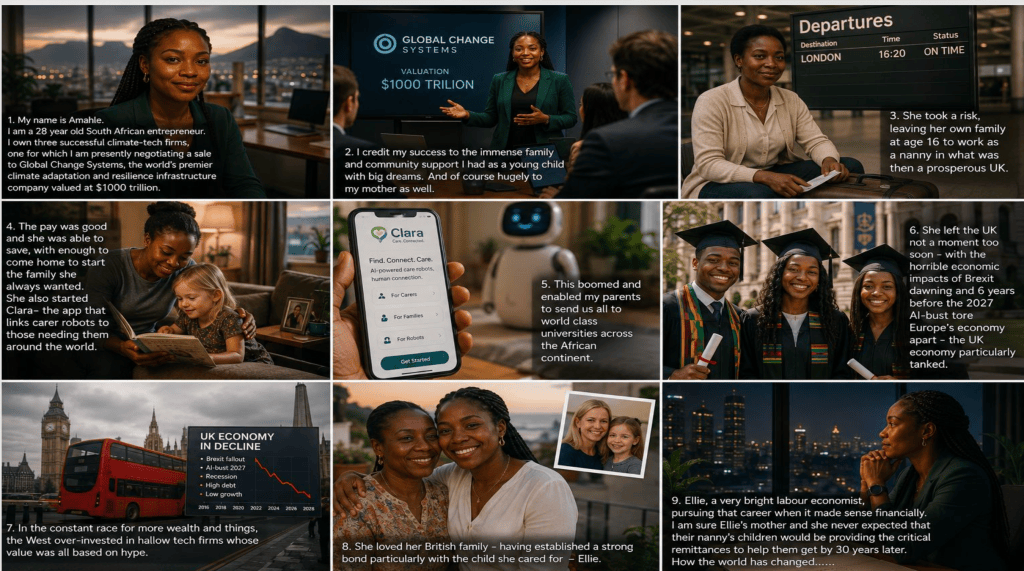
So we simply called it Ellie & Amahle.
The story was then passed to Darren Vukasinovic of Ex Animo Productions, who worked closely with us to translate the scenario into film, using AI as a creative tool while preserving the human emotions at its core.
AI helped us tell the story. It did not imagine the future for us.
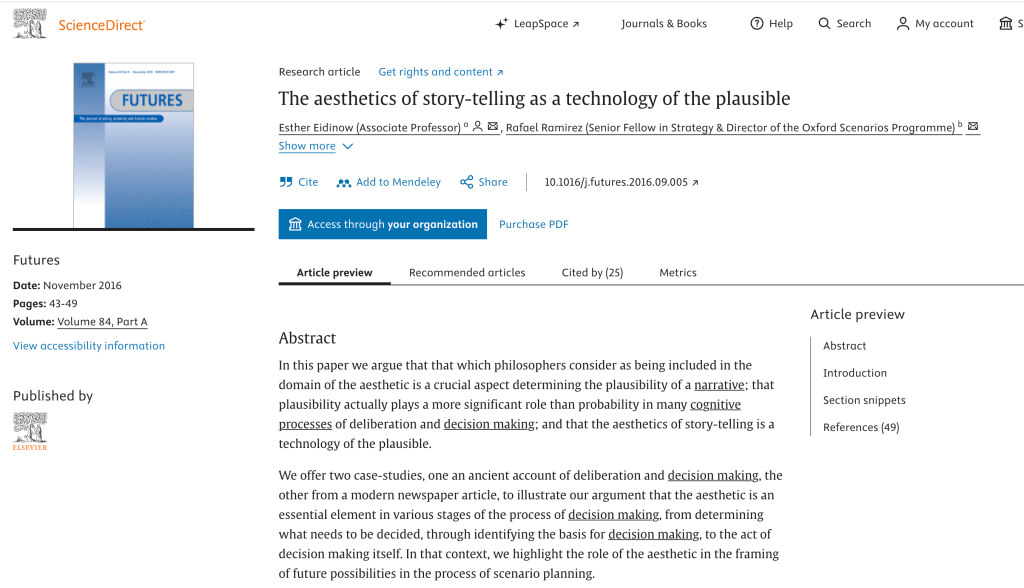
Here‘s an academic article on the use of storytelling as a technological tool to explore the future by our Professor, Rafael Ramirez and Research by Esther Eidinow who puts forward the case that storytelling acts as a“technology of the plausible”, i.e. narrative aesthetics shape what people perceive as plausible, while plausibility can matter more than probability in deliberation and decision-making. In scenario planning, stories therefore become disciplined tools for framing and exploring future possibilities.
Download the Ellie & Amahle Script here
Download the Ellie & Amahle Storyboard here
Note on the use of AI:
We could not have afforded to make a film of this scale without AI. AI democratised the production process, allowing us to visualise a richly imagined 2050 at a fraction of traditional production costs. But affordability is not authorship. AI provided the production capability; human imagination provided the story, values and emotional truth.
Darren Vukasinovic, Ex Animo Productions, maker of Ellie & Amahle:
We began with human experiences: uncertainty, fatigue, care, vulnerability, belonging, responsibility and the need to be connected to others. We then used disciplined scenario-building to construct the world in which those experiences could plausibly exist.
Only after that human story existed did AI enter the creative process.
The film’s shot design illustrates this distinction. Every scene is deliberately constructed to communicate a human idea: two people running with “the same effort, different air”; a long silence over an unexpected remittance; a family deliberately switching off technology at dinner; a community spending three hours resolving a shared problem; and, finally, two radically different measures of a day, transactions versus participation. The screenplay even specifies where silence, duration and juxtaposition should carry meaning without narration.
AI helps us render that imagined world. It can generate environments, interfaces and visual representations that would otherwise be extraordinarily difficult to produce.
But AI did not decide what should matter.
The values, contradictions, discomfort, tenderness and provocations were conceived by humans and shaped through human conversation. AI is therefore not the humanity in the loop. AI is a tool in the loop. Humanity created the loop.

